The contract is signed. The negotiation continues. Value does not move once. It moves across the lifecycle. Procurement does not treat negotiation as a meeting. It treats it as a system that runs before, during, and after the contract.
When suppliers treat it as an event, control is lost at every stage.
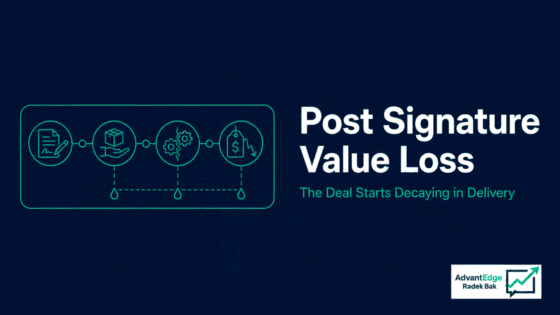
Post-signature negotiation is where signed value becomes either protected value or exposed value.
Where control is lost?
Most commercial teams operate with an event mindset. They prepare, negotiate, and sign-then move on. Procurement does not. The buyer system runs continuously:
Before the negotiation: Criteria are shaped and alternatives tested. The price corridor narrows.
During the negotiation: Information is filtered and concessions are extracted against internal logic.
At signature: The supplier thinks it is over. Procurement continues to negotiate terms.
After signature: Scope and service levels are adjusted through execution pressure.
If the supplier treats these as separate moments, procurement treats them as one continuous process. You have seen this: the deal looked won at signature, but value started moving afterwards.
What it costs?
This is not a process preference. It is a control failure.
- Upstream loss: Criteria are fixed before you enter. Price becomes the only lever.
- At-the-table leakage: Concessions move without a structured trade.
- False security at award: Leverage flips once the buyer selects you.
- Post-signature erosion: Delivery becomes negotiation without structure.
- No accumulated advantage: Each deal starts from zero without usable intelligence.
Value is not lost in one moment. It is lost across the lifecycle.
What must be installed?
Negotiation must be treated as a continuous control system.
- Control starts before the RFP: Decision criteria and stakeholders are mapped early.
- Execution is governed at the table: Concessions are traded, not given. Authority is controlled.
- Commitment is secured at signature: Terms are locked before behaviour shifts.
- Delivery is controlled commercially: Changes are treated as negotiated variables.
- Every deal feeds the next: Outcomes and buyer behaviour are captured and reused.
This turns negotiation from a sequence of events into a system that compounds advantage.
Relevant Negotiation Surgery™ entry point: Negotiating the Delivery™
Use the Control Gap Diagnostic to identify where your deals are losing control across the lifecycle.