You respond immediately. You fill the silence. You move first. The concession has already started.
In procurement-led negotiations, time and silence are not neutral. They are controlled variables.
Where control is lost?
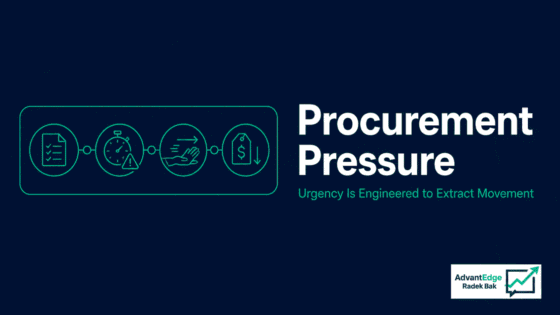
Most teams treat speed as progress. Procurement does not. It uses pace and pressure to extract information and movement. The pattern is consistent:
Silence is filled too quickly: Teams justify, explain, or adjust before the buyer moves.
Deadlines trigger reaction: Internal pressure is exposed and used as leverage.
Concessions appear without resistance: Movement happens to “keep the deal going”.
Emotion replaces structure: Aggression is mirrored. Urgency becomes visible.
Information is revealed under pressure: Constraints, limits, and dependencies become negotiable.
Procurement does not need to force movement. It waits. The supplier moves first. You have seen this. The discussion did not require pressure. The team created it.
What it costs?
This is not a behavioural issue. It is a control failure.
- Price erodes through premature movement.
- Leverage weakens as urgency becomes visible.
- Information asymmetry increases in favour of the buyer.
- Decision control shifts to the side that sets the pace.
- Negotiation becomes reactive instead of directional.
Once impatience is visible, the buyer does not need to accelerate. It lets the supplier do it.
What must be installed?
Strategic patience must govern time and silence as part of deal control.
- Silence is deliberate: After key statements, no additional information is offered.
- Pace is controlled: Deadlines are assessed, not accepted as pressure.
- Movement is conditional: No concession is made to “keep momentum”.
- Emotion is neutralised: Aggression is not mirrored. Urgency is not exposed.
- Information is protected: Constraints are resolved internally before they appear in the negotiation.
This shifts negotiation from reactive exchange to controlled progression.
Relevant Negotiation Surgery™ entry point: Wrestling with Procurement™
Use the Control Gap Diagnostic to identify whether impatience is already weakening your negotiation position.