How Procurement Decides™
Shape the deal before the formal request
Behind the Curtain™
Trade value with discipline
Negotiating the Delivery™
Prevent value leakage after signature
Wrestling with Procurement™
Resist pressure without reactive concessions
AI in Negotiation & Influencing™
Accelerate preparation without losing control
Prevent value leakage after signature
Negotiating the Delivery™
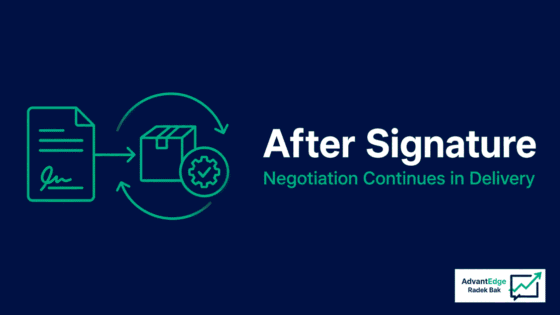
Negotiating the Delivery installs leadership and execution control so negotiated outcomes survive contact with reality.
This programme treats delivery as a negotiated environment, not an operational afterthought.
This programme controls post-signature execution. It does not replace upstream deal shaping or negotiation-table discipline.
Programme format
Company-specific intensive workshop for commercial, leadership, and delivery-facing teams protecting value after signature.
Built around pre-work, delivery scenarios, escalation logic, stakeholder authority, and structured exercises on post-signature value control.
Explore the sections below for scope, artefacts, audience, and delivery details.
1. The Problem (Why value erodes)
Many organisations treat delivery as operations, not negotiation.
As a result:
- commitments are re-interpreted under pressure
- stakeholders renegotiate scope informally
- concessions are made “to keep things moving”
- governance is replaced by escalation and goodwill
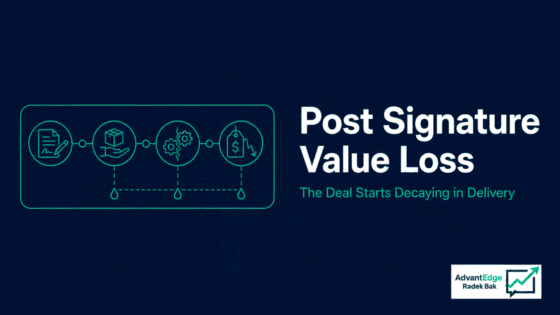
Negotiated value rarely disappears in one moment. It erodes through small, unmanaged renegotiations during execution.
Negotiating the Delivery addresses this failure mode directly.
2. The Scope (What it is)
Negotiating the Delivery focuses exclusively on control after agreement.
It does not:
- influence requirements, criteria, or leverage upstream
- train negotiation tactics or table behaviour
- rescue deals already structurally lost before signature
Those risks are handled by other modules in The Negotiation Surgery.
3. The Mechanism (What it installs)
This programme installs control over:
- Stakeholder negotiation during execution
How leadership, operations, and the counterparty continue negotiating after signature. - Commitment protection
What is fixed, what is flexible, and who is authorised to adjust what – and when. - Execution escalation logic
How issues are resolved without trading value for speed or convenience.
This is execution governance, not project management.
4. The Artefacts (Tangible outputs)
Negotiating the Delivery installs concrete execution artefacts, including:
- A Delivery Negotiation Map (stakeholders, authority, variables)
- Execution control rules defining non-negotiables and tradeable adjustments
- A post-signature escalation framework that protects value under pressure
These artefacts govern behaviour long after the contract is signed.
5. The Anti-Pitch (Differentiation)
Negotiating the Delivery is not:
- project management training
- contract administration or legal interpretation
- conflict resolution or communication coaching
It is a leadership-level control installation for execution under commercial pressure.
6. The Boundary (Disqualification)
This is not the right starting point if:
- the deal is already structurally disadvantaged upstream
- negotiation discipline at the table is the primary weakness
- the issue is purely operational, not commercial
In those cases, another module should be addressed first.
7. The Outcome (Future State)
After Negotiating the Delivery:
- Post-signature discussions stop drifting into silent renegotiation
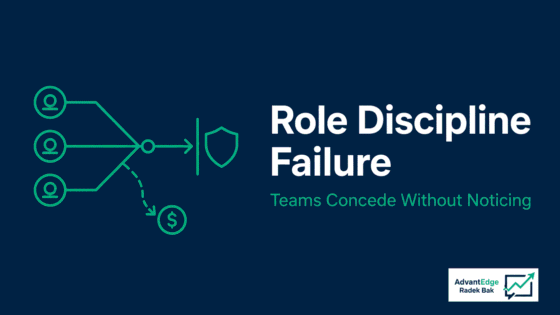
- Stakeholders understand what they can – and cannot – give away
- Delivery issues are resolved without eroding commercial outcomes
- Leadership intervenes deliberately, not reactively
Execution becomes a controlled continuation of the deal, not its undoing.
8. The Target (Who needs this)
This module is designed for those responsible for protecting commercial value during execution.
Primary Audience:
- Leaders accountable for delivery and outcomes
- Programme and Project Owners
- Cross-functional teams managing post-deal execution
It equips these roles to hold the line when operational pressure mounts.
9. Delivery Format
(How it is delivered)
Negotiating the Delivery is typically delivered through:
• A focused execution diagnostic
• A 1-2 day company-specific intensive workshop for commercial, leadership, and delivery-facing stakeholders
• Pre-work to surface current post-signature delivery challenges before the workshop
• Practical examples and structured exercises on scope changes, authority limits, escalation points, and value leakage risks
• Working artefacts your team can use after signature
• Optional advisory follow-up for selected delivery escalation situations, where agreed
The work is designed for practical use during post-signature execution.
Check if this is the right entry point
Related Deal Intelligence
Explore the full Post-Signature Value Loss section.