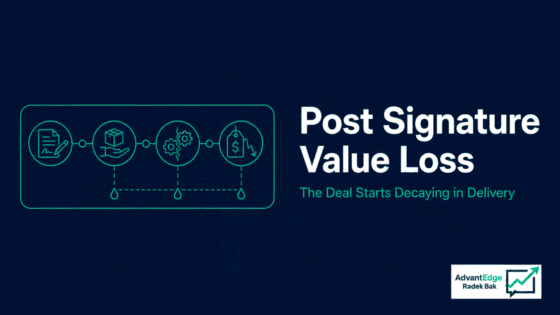
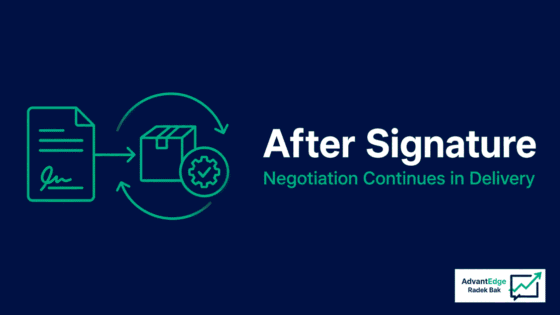
The contract is signed.
The scope starts moving.
A clarification becomes extra work. A service exception becomes the new expectation. A timing request becomes a delivery obligation. A practical adjustment becomes a commercial precedent.
Nothing is formally renegotiated.
The deal changes anyway.
This is where delivery stops being execution only and becomes a second negotiation environment.
Where control is lost?
After signature, scope changes reopen the commercial battle when operational pressure overrides the original deal logic.
Scope does not always expand through a formal change request.
It often expands through helpfulness, speed, escalation and unclear ownership.
Clarifications become commitments: What starts as explanation turns into an expected deliverable.
Exceptions become normal practice: One approval under pressure becomes the standard for the next request.
Operational teams inherit commercial exposure: Delivery solves the issue, but does not always see the value being transferred.
Procurement re-enters through execution: The buyer uses delivery friction to reopen cost, service, timing or responsibility.
Once scope movement becomes informal, the signed agreement stops protecting value.
It becomes the baseline for the next demand.
What it costs?
This is not delivery flexibility.
It is commercial exposure.
- Margin erodes through unpaid expansion: Extra time, work, responsiveness and coordination are absorbed without structured return.
- The contract boundary weakens: The buyer learns that pressure during execution can achieve what was not won at signature.
- Delivery teams become accidental negotiators: Operational decisions create commercial commitments without authority.
- Escalations reward movement: Senior intervention removes friction, but often confirms the buyer’s expanded expectation.
The commercial damage is rarely visible in one event.
It accumulates through repeated scope movement that nobody prices, trades or records.
What must be installed?
Delivery needs a commercial control loop, not just project follow-through.
- A scope movement register: Track every clarification, exception, extra task and buyer request that changes the effort or risk profile.
- Commercial ownership of delivery decisions: Delivery, sales and leadership need one rule for when operational support becomes negotiated change.
- Escalation rules with authority: Define who can approve scope movement, under which condition and at what commercial cost.
- Trade logic after signature: Extra work, faster response, additional service and risk transfer must trigger a defined return.
This shifts delivery from silent value absorption to controlled post-signature negotiation.
Relevant Negotiation Surgery™ entry point: Negotiating the Delivery™
Use the Control Gap Diagnostic to identify where scope changes are reopening the commercial battle after signature, and which delivery moments are creating value leakage.