
Introduction: The Signal Amidst the Noise
The modern procurement office is often synonymous with technology. We are constantly discussing Artificial Intelligence (AI) for predictive analytics, Machine Learning (ML) for demand forecasting, and sophisticated digital tools for automating the Purchase-to-Pay (P2P) cycle. The promise is clear: efficiency, speed, and massive cost savings driven by data.
However, in this exciting rush towards digitization, I often observe a critical flaw in strategic thinking. Teams become experts at optimizing transactions—the how—but lose sight of the strategic what and why. They miss the fundamental truth that underpins all effective sourcing: You can’t optimize what you haven’t mapped.
The core challenge for Chief Procurement Officers (CPOs) today is not a lack of data; it is, quite simply, a lack of strategic focus. Data alone cannot prioritize risk, identify geopolitical exposure, or dictate the appropriate supplier relationship model.
This is precisely why I believe the Kraljic Matrix, a foundational framework developed by Peter Kraljic in 1983, remains one of the most strategic tools in my arsenal.
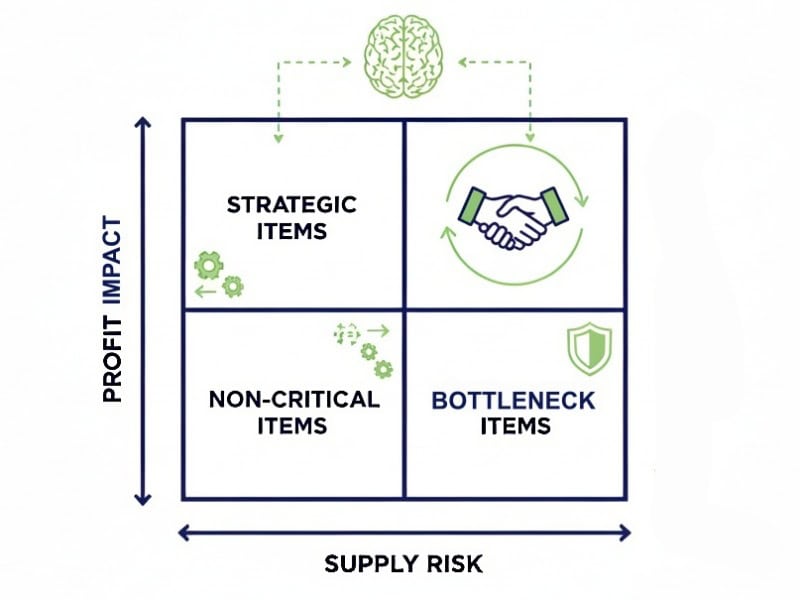
The Matrix itself is deceptively simple: it maps all purchasing items across two axes—Profit Impact and Supply Risk—creating four distinct strategic quadrants. It is powerful not because of its simplicity, but because it forces procurement professionals to answer the hard, non-negotiable questions:
- Where are we truly exposed in our supply base?
- Which suppliers really shape our competitiveness?
- What deserves strategic focus and relationship building, versus operational efficiency and automation?
- Where should I build true partnerships, and where should I automate?
Most organisations don’t fail in procurement because of a lack of data. They fail because of a lack of focus. And that’s exactly what Kraljic gives me: Clarity on where strategy should start.
Why the Kraljic Matrix Matters More Than Ever
Some critics dismiss the Kraljic Matrix as an outdated tool from the pre-digital era. I strongly disagree. Its relevance has only intensified because the volatility it seeks to manage has exponentially increased.
The business landscape today is defined by unprecedented complexity:
- Systemic Shocks: The recent decade has seen pandemics, major trade wars, and significant geopolitical conflicts, proving that supply risk is no longer a localized issue but a systemic threat.
- Reputational Vulnerability: A single failure in a distant part of the supply chain—related to labor practices or environmental damage—can cause immediate and catastrophic brand damage.
- Pressure for Speed: Global competition demands faster innovation and quicker time-to-market. Sourcing choices directly impact this speed.
The power of Kraljic is that it creates a common strategic language across the organization. It allows me, as a procurement leader, to communicate critical priorities to the CFO (focus on Profit Impact), the Legal team (focus on Supply Risk), and the Operations team (focus on Continuity).
Furthermore, the Matrix compels us to move beyond the transactional mindset. It forces the identification of Strategic Items—the 10-20% of spend that generates 80% of the long-term risk and value. This prevents the common trap of spending 80% of management time negotiating trivial Non-Critical Items, thereby freeing up valuable leadership time to focus on the relationships and contingencies that truly drive competitive advantage.
How to Modernize Kraljic for Today’s Risk & Sustainability Landscape
To be effective in the 2020s, I cannot apply the Kraljic Matrix using the definitions from 1983. Its genius lies in its flexibility, but I must redefine its two core axes to reflect modern realities.
A. Redefining Supply Risk (The Horizontal Axis)
Traditional supply risk was often a calculation of scarcity or the difficulty of substitution. Today, I must incorporate system-wide risk factors:
- Geopolitical Risk: Assessing a supplier’s location relative to trade instability, tariffs, sanctions, and political unrest. A low-cost item sourced from a volatile region might instantly become a Bottleneck Item if this risk is high.
- ESG and Ethical Risk: This is non-negotiable. I must evaluate the supplier’s performance on environmental impact, labor practices, and governance standards. High ESG risk (e.g., modern slavery, high carbon footprint) automatically elevates the overall Supply Risk score, regardless of availability.
- Cyber and IT Risk: For any digital service or technology component, the risk of a data breach or intellectual property theft becomes paramount. This must be factored into the risk score alongside physical supply.
- Single-Source Vulnerability: Modernization involves quantifying the cost of supply disruption, not just the probability. Items with high switching costs or specialized tooling instantly score higher on the risk axis.
B. Elevating Profit Impact (The Vertical Axis)
Profit Impact must also evolve beyond simple Cost of Goods Sold (COGS). Procurement now drives top-line value:
- Innovation Potential: Does the supplier offer co-development, access to proprietary technology, or R&D collaboration that could provide my organization with a market-leading product? If the answer is yes, the Profit Impact score is automatically high, pushing the item towards the Strategic quadrant.
- Sustainability Contribution: Sourcing recycled, circular, or carbon-neutral materials directly contributes to my brand’s narrative, consumer preference, and regulatory compliance. This is a massive long-term profit advantage.
- Resilience Value: The ability of a supplier to react quickly to changes (agility) provides an indirect but significant profit advantage by minimizing downtime and maximizing responsiveness.
By enriching both axes with these critical modern dimensions, the Kraljic Matrix transforms from a simple classification tool into a powerful, contemporary Risk and Value Prioritization Framework.
The Biggest Mistakes Teams Make When Applying It
Implementing Kraljic correctly requires discipline. I often observe two major pitfalls in organizations:
Mistake 1: Treating Kraljic as a Static Classification Exercise. Teams spend weeks meticulously mapping, then treat the categories as fixed. The Matrix must be a dynamic strategy tool reviewed at least annually, or immediately after a major market shock. An item can and should move quadrants based on changes in the market, technology, or my negotiation strategy.
Mistake 2: Applying Uniform Strategy Across Quadrants. The Matrix exists to mandate four fundamentally different strategic approaches. Teams often fail by applying aggressive price negotiation (suitable for Leverage items) to their Strategic suppliers, destroying long-term partnerships, or by neglecting the necessary risk mitigation for Bottleneck items, leading to crisis. The strategy must be tailored: Partnership (Strategic), Efficiency (Non-Critical), Price Aggression (Leverage), and Risk Reduction (Bottleneck).
How to Use Kraljic to Build a True Category Strategy
The Kraljic Matrix is the foundation for a true Category Strategy. Once I have accurately mapped all my spend, the quadrant dictates the roadmap for the next 3-5 years:
- Strategic Quadrant: The roadmap focuses on collaboration, co-development, and joint disaster planning. The goal is resilience and innovation, not cost reduction.
- Leverage Quadrant: The roadmap focuses on aggregated volume, standardization, and executing aggressive, market-driven tenders (RFP/Auction). The goal is cost leadership.
- Bottleneck Quadrant: The roadmap focuses on identifying new suppliers, qualifying substitutes, and re-engineering products to eliminate dependency. The goal is risk reduction.
- Non-Critical Quadrant: The roadmap focuses on automation, outsourcing, and reducing the total cost of ownership (TCO) through efficiency.
Conclusion: The Power of Clarity
In an age dominated by technology, I believe the timeless principles of the Kraljic Matrix offer a powerful anchor. It cuts through the digital chaos and brings us back to the fundamental questions of strategic sourcing. When modernized—incorporating ESG, geopolitical, and innovation risk—it becomes the indispensable filter for prioritizing effort and resources.
If you want your procurement team to think—and act—more strategically, this classic framework provides the clarity needed to transform buying into a competitive advantage.







2 comments
Thank you for the highly informative and high-quality knowledge shared. The strategic guidance was clear, actionable, and to the point.
Namaste Suvarna, I am glad my blog’s content meets your expectations. I trust applying the concepts and models in real-life situations will produce benefits for you and those around you.